 1 / 35
Cypherpunks Mailing List Puzzle
PRODUCTION UPDATE
I originally published this text before the puzzle had been fully produced. The first test piece was successfully cut with a plotter, but the following attempts revealed a fundamental technical problem: the pieces did not align correctly where the nine segments printed across two sheets met. This version could therefore not be used for the final edition.
I had the artwork printed again in a new 60 × 80 cm format and found a specialist puzzle manufacturer. The final prints are currently being mounted there and prepared for professional die-cutting. These complications extended the development and production of the project by approximately a year and a half. The resulting edition, however, will finally correspond to the original idea of a fully functional collectible puzzle.
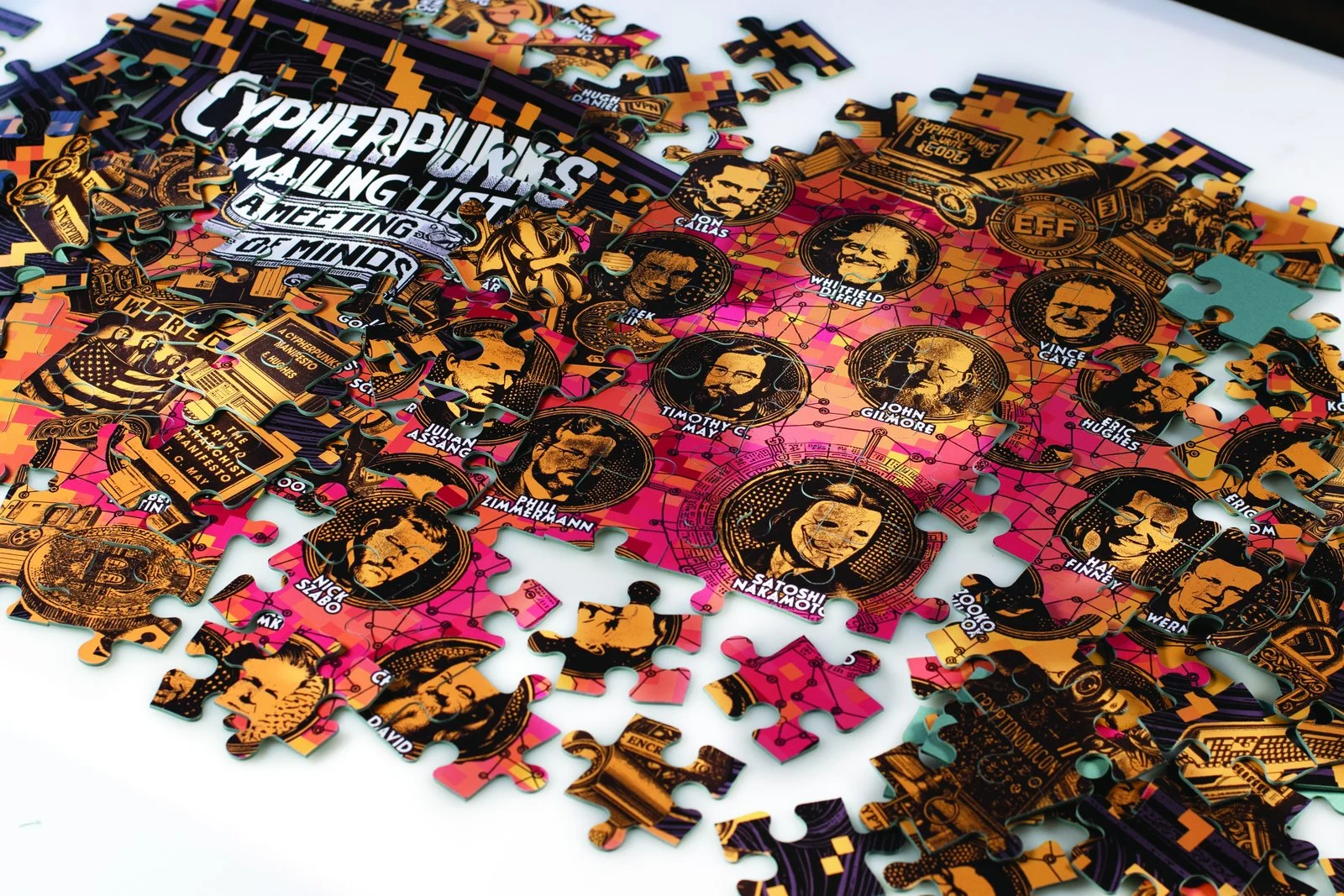
The project began in 2024 as the opening illustration for a chapter about the Cypherpunks Mailing List in the book Smashtoshi. The history of the cypherpunk movement struck me as a puzzle: individual ideas, discoveries and people gradually fit together and lead toward bitcoin. One piece, however, is missing. Satoshi Nakamoto never contributed to the mailing list and remains the only anonymous figure in the story.
While gathering source material, I searched the mailing-list archive and Bitcoin Wiki. For some figures, finding even a single usable photograph proved difficult, which influenced the final selection of portraits. Each portrait was generated with AI in the style of a vintage engraving and then refined by hand and digitally. The other elements of the collage were created in the same way.
I disrupted the overly smooth digital images with Gelli printing, an analog process that transfers xerographic copies onto paper. I printed each element by hand, scanned it and placed it back into the final composition. The imperfections of the process gave the synthetic images a physical texture and a human touch.
The original 70 × 70 cm collage was digitally printed and cut into a puzzle for the photograph used in Smashtoshi. Because an exceptional amount of work had gone into a single image, I decided to develop the motif into a hand-printed edition of 21.
The dimensions of the original cutter required me to divide the image into nine segments printed across two sheets. For screen printing, I reduced the full-color digital design to nine colors, mixed by hand from pigments and an acrylic base. The complete process required eighteen separate preparations and print runs. Although the first plotter-cut sample worked, the following puzzles did not align correctly where the printed segments met. I therefore abandoned this production method. The artwork was subsequently printed again in a 60 × 80 cm format, and the final edition is now being mounted and prepared for professional die-cutting by a specialist puzzle manufacturer.
The set includes a double-sided poster. The complete image on the front serves as a guide for assembling the puzzle; the reverse introduces the individual cypherpunks, important elements of the collage and the number of their contributions to the mailing list. While verifying this information, I discovered that David Chaum had never posted to the list. I nevertheless kept him in the composition as one of the figures whose work laid the foundations of cypherpunk thought.
The final puzzle will be wrapped in tissue paper printed with a collage of newspaper answers to the question “Are you Satoshi Nakamoto?” Together with the folded poster, it will be placed in a numbered box printed inside and out. A link on the bottom will lead to a digital certificate of authenticity recorded on the Bitcoin blockchain through Verisart. The certificate will contain a description and complete photographic documentation of the signed puzzle, both sides of the poster and the box, allowing the contents to be verified without breaking the protective seal.
Piece together 28 cypherpunk figures and the anonymous Satoshi Nakamoto
The Cypherpunks Mailing List
Launched in 1992, was an online forum that became a hotbed for ideas and debate about cryptography, privacy, and the potential for digital currencies. The mailing list served as a meeting place for some of the brightest minds in the field, many of whom would later play key roles in the development of Bitcoin.
John Gilmore
Author of 457 posts
Activist. He is one of the founders of the Electronic Frontier Foundation, the Cypherpunks mailing list, and Cygnus Solutions. He created the alt.* hierarchy in Usenet and is a major contributor to the GNU Project.
Eric Hughes
Author of 1027 posts
Mathematician, computer programmer, and cypherpunk. He is considered one of the founders of the cypherpunk movement, alongside Timothy C. May and John Gilmore. He is notable for founding and administering the Cypherpunk mailing list, authoring A Cypherpunk's Manifesto, creating and hosting the first anonymous remailer, and coining the motto, "Cypherpunks write code"
Hal Finney
Author of 728 posts
Cryptographer, main author of PGP 2.0 and the core crypto libraries of later versions of PGP; designer of RPOW. An early bitcoin user, received the first bitcoin transaction from bitcoin’s creator Satoshi Nakamoto.
Wei Dai
Author of 132 posts
A computer engineer known for contributions to cryptography and cryptocurrencies. He developed the Crypto++ cryptographic library, created the b-money cryptocurrency system, and co-proposed the VMAC message authentication algorithm.
David Chaum
A computer scientist, famous for developing ecash, an electronic cash application that aims to preserve a user’s anonymity. His 1981 paper, “Untraceable Electronic Mail, Return Addresses, and Digital Pseudonyms”, laid the groundwork for the field of anonymous communications research.
Excuse the mistake, David Chaum was not on the mailing list.
Nick Szabo
Author of 80 posts
A computer scientist and cryptographer known for his research in smart contracts and digital currency. In 1998, Szabo designed a mechanism for a decentralized digital currency he called "bit gold". Bit gold was never implemented, but has been called "a direct precursor to the Bitcoin architecture.
Phil Zimmermann
Author of 42 posts
Computer scientist and cryptographer. He is the creator of Pretty Good Privacy (PGP), the most widely used email encryption software in the world. He is also known for his work in VoIP encryption protocols, notably ZRTP and Zfone. Zimmermann is co-founder and Chief Scientist of the global encrypted communications firm Silent Circle.
Timothy C. May
Author of 4114 posts
One of the founders of the cypherpunk group, wrote many political papers explaining the group’s objectives to the online community. Working as a leading scientist at Intel, May wrote in his spare time about the importance of cryptography to protect user information. He wrote such works as a substantial cypherpunk-themed FAQ, “The Cyphernomicon” (incorporating his earlier piece “The Crypto Anarchist Manifesto”) and “True Nyms and Crypto Anarchy”. Many of the ideas expressed in his works became a reality.
Adam Back
Author of 744 posts
Cryptographer and crypto-hacker notable as the inventor of Hashcash, the proof-of-work system used by Bitcoin.
Eric Blossom
Author of 82 posts
Designer of the Starium cryptographically secured mobile phone, founder of the GNU Radio project.
Zooko Wilcox
Author of 161 posts
Worked on the first cryptocurrency, DigiCash, with David Chaum in 1996. He is a member of the founding team of the anonymous cryptocurrency Zcash.
Perry Metzger
Author of 1940 posts
After Gilmore shut down the original mailing list, others sprang up in its place, with several dedicated to improving crypto. The most notable was the cryptography mailing list hosted by Perry Metzger, where many of the original cypherpunks migrated.
Robert Hettinga
Author of 1483 posts
Founder of the International Conference on Financial Cryptography and originator of the idea of Financial cryptography as an applied subset of cryptography.
Michael Froomkin
Author of 217 posts
His work on technology law since the mid-1990s spans Internet governance and regulation, privacy, encryption, AI and medicine, drones, and robotics.
Vince Cate
Author of 252 posts
A cryptography software developer based in Anguilla. He gave up his U.S. citizenship in 1998 in protest of U.S. laws on the export of cryptography. Cate engaged in civil disobedience against U.S. cryptography policy by setting up a webpage inviting readers to "become an international arms trafficker in one click".
Julian Assange
Author of 81 posts
A well-known cypherpunk who advocates for the use of cryptography to ensure privacy on the Internet, also editor, publisher, and activist who founded WikiLeaks.
Steven Schear
Author of 4 posts
Creator of the warrant canary, and GNURadio, team member Counterpane, former Director at data security company Cylink and MojoNation, current Vice President at StashCrypto.
John Young
Author of 1844 posts
Anti-secrecy activist and cofounder of Cryptome.
Whitfield Diffie
Author of 5 posts
Cryptographer and mathematician and one of the pioneers of public-key cryptography along with Martin Hellman and Ralph Merkle.
Derek Atkins
Author of 40 posts
Computer scientist, computer security expert, and one of the people who factored RSA-129.
Martin Hellman
Author of 132 posts
Cryptologist and mathematician, best known for his invention of public-key cryptography in cooperation with Whitfield Diffie and Ralph Merkle.
Bruce Schneier
Author of 67 posts
Privacy specialist and writer. The author of several books on general security topics, and cryptography.
Hugh Daniel
Author of 59 posts
Former Sun Microsystems employee, manager of the FreeS/WAN project (an early and important freeware IPsec implementation).
Jon Callas
Author of 17 posts
Technical lead on OpenPGP specification, co-founder and Chief Technical Officer of PGP Corporation, co-founder with Philip Zimmermann of Silent Circle.
Paul Kocher
Author of 1 post
President of Cryptography Research, Inc., co-author of the SSL 3.0 protocol., Principal Cryptographic Engineer for PGP Corporation, Co Founder of Silent Circle., Co Founder 4th-A Technologies, LLC.
Ian Goldberg
Author of 156 posts
Professor at University of Waterloo, designer of the Off-the-record messaging protocol.
Johan Helsingius
Author of 124 posts
Creator and operator of Penet remailer.
Werner Koch
Author of 1 post
Free software developer. He is best known as the principal author of the GNU Privacy Guard (GnuPG or GPG).
Satoshi Nakamoto
Author of 0 posts
Anonymous creator(s) of the decentralized Bitcoin cryptocurrency, and inventor(s) of the blockchain technology.
The puzzle also depicts key elements of the movement
Cypherpunks write code
It was Hughes who coined the expression that would define them: “cypherpunks write code.” Above all, the code they wanted to write was encryption. Encryption is the art and science of keeping things secret from people you don't want to know them, while revealing them to those you do.
The Electronic Frontier Foundation (EFF)
The Electronic Frontier Foundation (EFF) is an international non-profit digital rights group based in San Francisco, California. It was founded in 1990 to promote Internet civil liberties.
Cryptonomicon
In Neal Stephenson's novel Cryptonomicon many characters are on the "Secret Admirers" mailing list. This is fairly obviously based on the cypherpunks list, and several well-known cypherpunks are mentioned in the acknowledgements.
Cryptography export controls
Phil Karn sued the State Department in 1994 over cryptography export controls after they ruled that, while the book Applied Cryptography could legally be exported, a floppy disk containing a verbatim copy of code printed in the book was legally a munition and required an export permit, which they refused to grant. Daniel J. Bernstein, supported by the EFF, also sued over the export restrictions, arguing that preventing publication of cryptographic source code is an unconstitutional restriction on freedom of speech. He won, effectively overturning the export law.
Crypto Rebels — Wired
The first mass media discussion of cypherpunks was in a 1993 Wired article by Steven Levy titled Crypto Rebels. The three masked men on the cover were prominent cypherpunks Tim May, Eric Hughes and John Gilmore.
The Cuckoo’s Egg
The Cuckoo's Egg: Tracking a Spy Through the Maze of Computer Espionage is a 1989 book written by Clifford Stoll (a member of the Cypherpunks mailing list). It is his first-person account of the hunt for a computer hacker who broke into a computer at the Lawrence Berkeley National Laboratory
A Cypherpunk’s Manifesto
Eric Hughes published ‘A Cypherpunk’s Manifesto’ in 1993, which can be considered as holy text of this movement. “Privacy is necessary for an open society in the electronic age. Privacy is not secrecy. A private matter is something one doesn’t want the whole world to know, but a secret matter is something one doesn’t want anybody to know. Privacy is the power to selectively reveal oneself to the world.”
The Crypto Anarchist Manifesto
In 1992 Timothy May published ‘the Crypto Anarchist Manifesto’ “Computer technology is on the verge of providing theability for individuals and groups to communicate and interact with each other in a totally anonymous manner. Two persons may exchange messages, conduct business, and negotiate electronic contracts without ever knowing the True Name, or legal identity, of the other.”
VPN
The oldest VPN protocol is the Point-to-Point Tunneling Protocol (PPTP). Introduced in the mid-1990s by a consortium led by Microsoft, PPTP was one of the first technologies to allow secure connections over the internet, effectively creating a virtual private network.
Pretty Good Privacy (PGP)
Pretty Good Privacy (PGP) is an encryption program that provides cryptographic privacy and authentication for data communication. PGP is used for signing, encrypting, and decrypting texts, e-mails, files, directories, and whole disk partitions and to increase the security of e-mail communications. Phil Zimmermann developed PGP in 1991.
Bitcoin
Several key figures from the Cypherpunks community, made significant contributions to Bitcoin’s early development. Their involvement can be traced back to their exploration of digital cash and pseudonymous transactions, principles that formed the basis of Bitcoin’s design.
The making of the collage
The faces of the cypherpunks are inspired by the few photos available online. However, these are entirely new portraits, as each one is created with the help of AI, just like all the elements of the collage. Each element is then printed using the gelli printing technique to add a patina and remove the artificial feel of AI. The final motifs are scanned and digitally reassembled into a finished collage, which is screen-printed in a limited edition of 21 copies
CypherpunkNOW studio
The concept, graphic design, and printing were created at the CypherpunkNOW studio in Prague 2024
CYPHERPUNK FUTURE IS NOW